



#131 Why Does TMD Sometimes Feel Like an Earache?
Earache is one of the most common symptoms associated with TMD, (Temporomandibular Joint Disorder). Patients report variations in the degree and frequency of the pain. It can be intermittent or continuous, sharp and stabbing, or dull and annoying.
When these pains become frequent and/or recurring, patients most often seek treatment at convenient care clinics or their primary care physician. An examination of the external auditory canal using an otoscope, which is a small speculum or funnel shaped device with a light and magnifying lens enabling the provider a view of the external portions of the ear all the way to the tympanic membrane, (Eardrum). The eardrum separates the external ear canal from the middle ear which houses the hearing mechanism and the vestibular mechanism which coordinates body movement in three dimensions and keeps us upright and balanced.
What the health care provider is looking for is evidence of inflammation of the tympanic membrane and/or external ear canal leading to the tympanic membrane. What they are expecting to find is swelling or redness of the membrane or the walls of the canal. If they see either redness and/or swelling the most likely cause is an infection. The standard treatment would be a 3-to-5-day course of broad-spectrum antibiotics like Amoxicillin.
The problem is often the physician’s assistant at the convenient care clinic or the primary care physician does not see evidence of inflammation even though the patient is insistent that they have an earache. In these cases, the provider is puzzled but prescribes the antibiotic anyway because that is their most common treatment for a common earache. They just ignore the lack of evidence of inflammation and infection. Most importantly, they never think about earache being one of the most common symptoms of TMD. Physicians, physician’s assistants, and nurse practitioners were never taught about TMD in their medical training and patients with an earache never think about going to their dentist to see if their symptoms are cause by TMD.
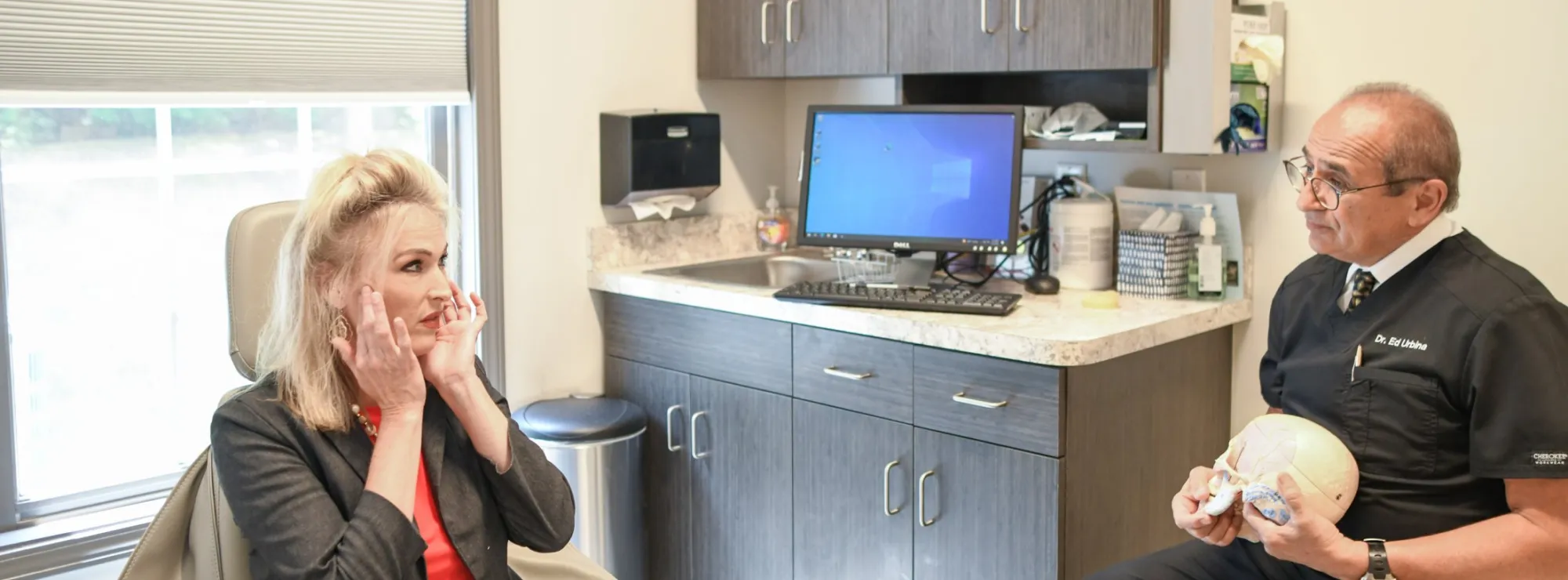
It is easy to distinguish pain from a middle ear infection and pain associated with TMD. If TMD is causing the symptom of earache, the TMJ, Temporomandibular Joint will be painful when a finger is placed in the joint space while the patient closes their mouth rapidly from the open to closed position. (OUCH!!) If that elicits pain and there is no evidence of inflammation of the tympanic membrane or ear canal the diagnosis is TMD.
Looking at an anatomy book reveals that the TMJ, (jaw joint) is separated from the external auditory canal by a paper-thin layer of bone. TMD is better described as inflammation of the TMJ. When the TMJ becomes inflamed due to overuse during clenching and grinding, acute trauma, or functional malocclusion, the inflammatory cells and fluids within the TMJ penetrate the paper thin bone separating the TMJ form the external ear canal. The pain receptors located in the periosteum covering this paper-thin layer of bone are stimulated and the patients perceive they have an earache even though there is no ear infection present.
It is not uncommon for patients to arrive at our office having seen several health care providers having prescribed several rounds of antibiotics for “ear infections” that turned out to be TMD delaying successful treatment for months and sometimes years. We see several patients with this history each week. Fortunately, here in Middle Tennessee, due to our ongoing educational efforts, there is a growing number of PCP’s, physician’s assistants, and nurse practitioners who know how to distinguish an ear infection from TMD.
Now you know why TMD sometimes feels like an earache. The inflammation within the TMJ penetrates the paper-thin bone which separates the jaw joint from the ear canal stimulating the pain sensors covering this paper thin bone.
With your new knowledge you are now ready to take on the position as a “Diagnostic Clinical Assistant for Earaches” at the convenient care clinic of your choice.
Comments are closed.