


#191 A Patient with TMD Run in Circles is a Sobering Experience
Many would call me an empath. I don’t like to see people hurt and in pain. As a surgeon, I found myself very uncomfortable doing surgery that I knew would cause a lot of post-surgical pain. Thank God for Demerol and Morphine. Forty-Eight hours on pain medication after the most complicated surgery, the patient was able to say that the pain was tolerable. Once the pain was on the down slope, it only got better from there.
As a young surgeon, I founded two medical/dental clinics in the third world, one in Haiti, and one in Jamaica because I thought it was my responsibility to use my skills and knowledge to help those who had no one to help them. Both turned out to be very successful.
I wanted to be a doctor and then become a surgeon specializing in maxillofacial reconstruction because I thought becoming a surgeon was the ultimate challenge. I must admit, at times, I questioned whether I had taken on too big a challenge. But I always pushed forward, one day at a time, thinking that I just needed to get through this one day, just get through the next examination, just get through the one difficult course I was tracking, that I’d eventually get where I was going. I had hope and confidence in my own abilities. Eventually I got to where I wanted to go and do what I wanted to do.
For the first 36 years of my 50-year surgical career, I thought the solution for Temporomandibular Joint Disorder (TMD) was going to come from the next surgical breakthrough, or the next conference on the Temporomandibular Joint (TMJ). But after 36 years and over 2000 cases, I had to admit to myself that surgeons did not have a long-term solution for TMD. I decided to stop doing surgery for TMD and decided to see if I could figure out what others had not been able to figure out about the disease.
The story of how I figured out the real cause, the common denominator of the disease, the thing that caused all the symptoms, and figured out how to treat it non-surgically is covered in many other places, podcasts, this blog, and videos on You Tube.
But after I figured it out and applied it successfully to over 5000 patients, I experienced something very unexpected. I thought other doctors would jump at the chance to duplicate the success of my practice in treating TMD. I thought once I began to share this knowledge with my colleagues, they would quickly stop what they were used to doing and apply a simple technology that changed the paradigm to treating TMD. That did not happen. What I experienced was a lot of push back, some overt, but most covert.
There has been progress for sure. We now have 50 doctors in over 20 states who use the Urbanek Device and Protocol to successfully treat patients with TMD. But overall, mostly what I encountered was and is a lot of push back wanting to keep things the way they are. No one disputes the science behind what I discovered. No one can. Science is science and fact is fact. When I invited the other doctors to criticize what I discovered, there were only crickets.
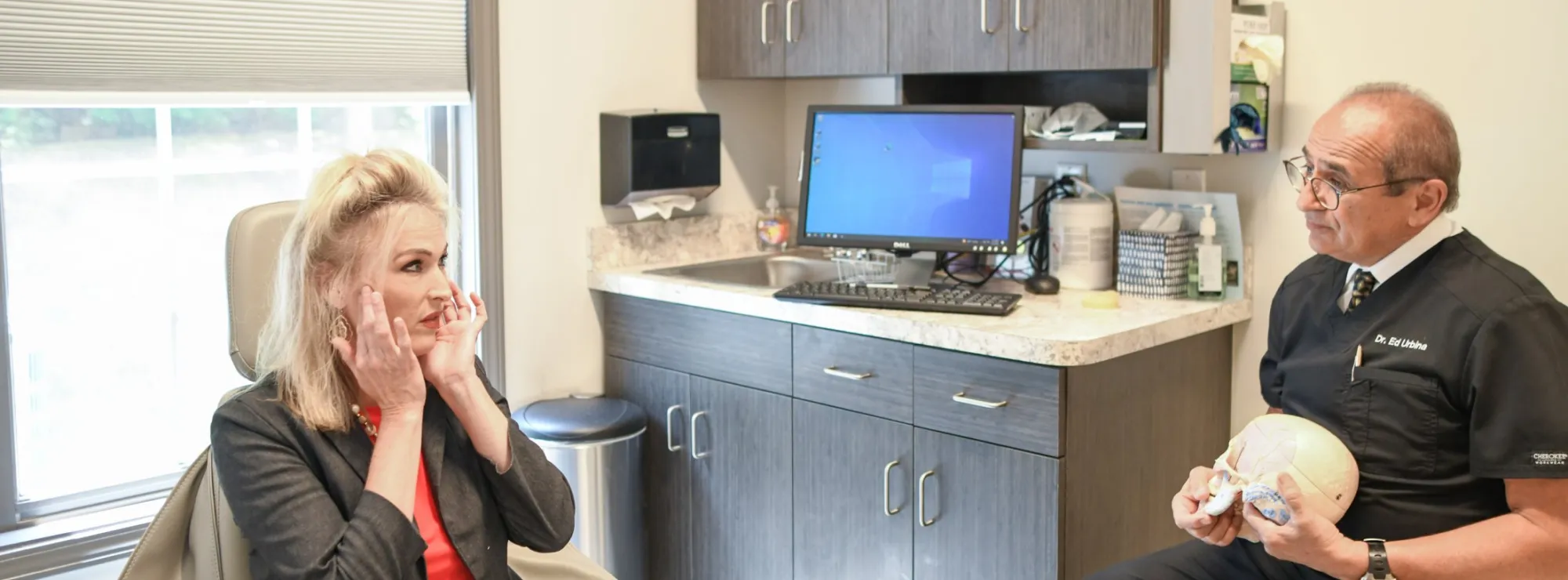
Last Monday I did a consult for a 25-year-old female who exhibited each and every one of the disparate symptoms of TMD since she was 18. She had most of these debilitating symptoms for over 6 years. In her community, only an hour drive from Nashville, she had been passed from doctor to doctor, clinic to clinic, and convenient care clinic to ER looking at every possible reason for her debilitating headaches, earaches, facial and neck pain, tinnitus, subjective hearing loss, vertigo, upper back and shoulder pain, and arm/hand/finger tingling and numbness. She is now experiences tremors in her hands as a side effect of the years of prescribed drugs for her headaches. She had been run around in circles for 6 solid years with all the symptoms getting worse over time until someone finally said she might have TMD.
I really feel sorry for her, and the thousands of patients like her, who have been abused by our medical/dental system because the new paradigm threatens the status quo. It is a sobering and very disappointing experience to admit that adherence to the way things are takes precedence over opening the mind. The litany of stories that prove this point will have to wait for a future article or podcast. To be sober is looking at things the way they are. It may not be comfortable to become sober, but becoming sober and waking up is the most important part of the solution to any problem. Something is terribly wrong with our system that allows a patient to be shuttled around for six years, and often decades. It just should not happen. It’s not an occasional occurrence. Many of our patients have had obvious symptoms for decades and treated for Migraine Headaches with nervous system suppressive drugs that have profound side effects. It’s time to confront this issue head on.
Comments are closed.