





#175 All the Information Was Available While Dentists Didn’t Bother to Read It
Temporomandibular Joint Disorder, TMD has been an enigma for the dental procession for over 70 years while all the information to solve the puzzle has been available in scientific literature all along. That is a fact.
The Orthopedic Surgeons call it “Joint Splinting” euphemistically. It is a very simple concept if you understand a couple of things about joints, nerves, and muscles. 1.) Muscles are there to create motion. 2.) Joints are there to help muscles create motion through leverage. 3.) Nerves are there to coordinate the activity between the muscles and the joints. Very, very simple. Dentists know this. This is taught in every dental school in their courses of Gross Anatomy and Neuroanatomy. Physicians are taught the same information in their courses on Gross Anatomy and Neuroanatomy.
So why have the physician Orthopedic Surgeons done such a great job of solving the problems associated with damage to the joints of the body and the dentists have done such an abysmal job of solving TMD?
There are two answers. 1.) Dental schools teach that the Temporomandibular Joint, TMJ is unlike every other joint in the body. They teach the TMJ is complicated. It must be complicated because it has a complicated designation, (Ginglimo-arthrodial). And they use this as the justification for why dentists haven’t solved the problem. And 2.) Dentists don’t read scientific literature like Orthopedic Surgeons do. If they did, they would have come across the fact that when a joint becomes damaged it sends a signal through the nervous system to the brain stem announcing there is inflammation in the joint. The brain stem then sends a signal back down through the nervous system to hold the joint motionless to assist in healing. This is called “Joint splinting” and operates in the same way for ALL the joints in the body including the TMJ. When the muscles that move the jaw get the signal to keep the jaw joint from moving, the result is headaches, earaches, jaw pain, neck pain, upper back and shoulder pain, arm/hand/finger tingling and numbness, and various kinds of jaw locking.
Here is how “Joint Splinting” is described in the scientific literature.
Inflammation within a joint activates articular nociceptors and mechanoreceptors that alter afferent input to spinal and brainstem reflex circuits. These neural signals modify motor neuron excitability and change the activity of the muscles surrounding the joint, producing protective stabilization or splinting of the inflamed joint. This phenomenon, often described as arthrogenic muscle inhibition or reflex muscle guarding, has been well documented in orthopedic research (Hurley 1997; Hopkins & Ingersoll 2000) and applies equally to the neuromuscular control of the temporomandibular joint.
And here is a diagram which describes the phenomenon visually.
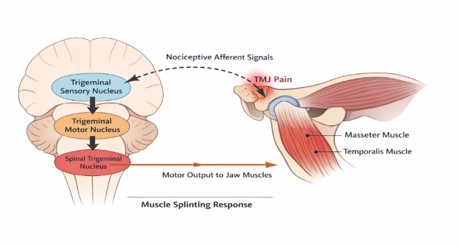
This paragraph and diagram explain the painful symptoms of TMD. I did not discover this pathophysiologic mechanism. It was in scientific literature and I read it there. It is upon this knowledge the Urbanek Device and Protocol was developed. I didn’t do anything particularly unusual. Anyone prior to me could have read the literature and connected the dots. It amazed me that it took 70 years for someone to come along and do that.
Comments are closed.