






#201 Impacted Wisdom Teeth and TMD
What do Impacted Wisdom Teeth and TMD have in common. The answer is PAIN!
In my 50-year career as an Oral and Maxillofacial Surgeon I have taken out hundreds of thousands of Impacted Wisdom Teeth and done consultations with over 10,000 patients with TMD. So, it is safe to say that I have a lot of experience with both problems. But they are very different problems.
Impacted Wisdom Teeth, properly called third molars are the last teeth in both the upper and lower dental arch. Therefore, there are four Wisdom Teeth, two in the upper arch, right and left side, and two in the lower arch, right and left side. They are commonly called Wisdom teeth because they usually erupt at around 18 years of age when our culture considers the person an adult and hopefully has attained a certain amount of wisdom. Of course, that concept is highly debatable and cannot be proven in the majority of cases.
During the early development Homo Sapiens, millions of years ago, the jaws were much larger in comparison to the size of the brain case, or skull. As the human body developed over the millennia the brain case got bigger and the size of the jaws got smaller. After thousands of years humans ended up with a total of 32 teeth in size 28 jaws. There was not enough room for the last four teeth, and in most cases are “stuck” or impacted behind the second molars.
Unless someone has unusually large jaws, most third molars become impacted. You may ask, so what? If the teeth are impacted and do not erupt completely, what is the big deal? Why not leave them there? The problem is impacted third molars create three significant problems if not removed.
- Cysts and tumors frequently form around impacted 3rd molars
- Impacted 3rd molars frequently damage the 2nd molars that are adjacent.
- Impacted 3rd molars can get inflamed, infected, and painful.
Therefore, it is recommended that impacted 3rd molars should be removed as soon as they develop. As much as 75% of the population have impacted 3rd molars. This certainly keeps the Oral and Maxillofacial Surgeons busy.
The problem is TMD also causes pain that is frequently misdiagnosed as, and associated with impacted 3rd molars.
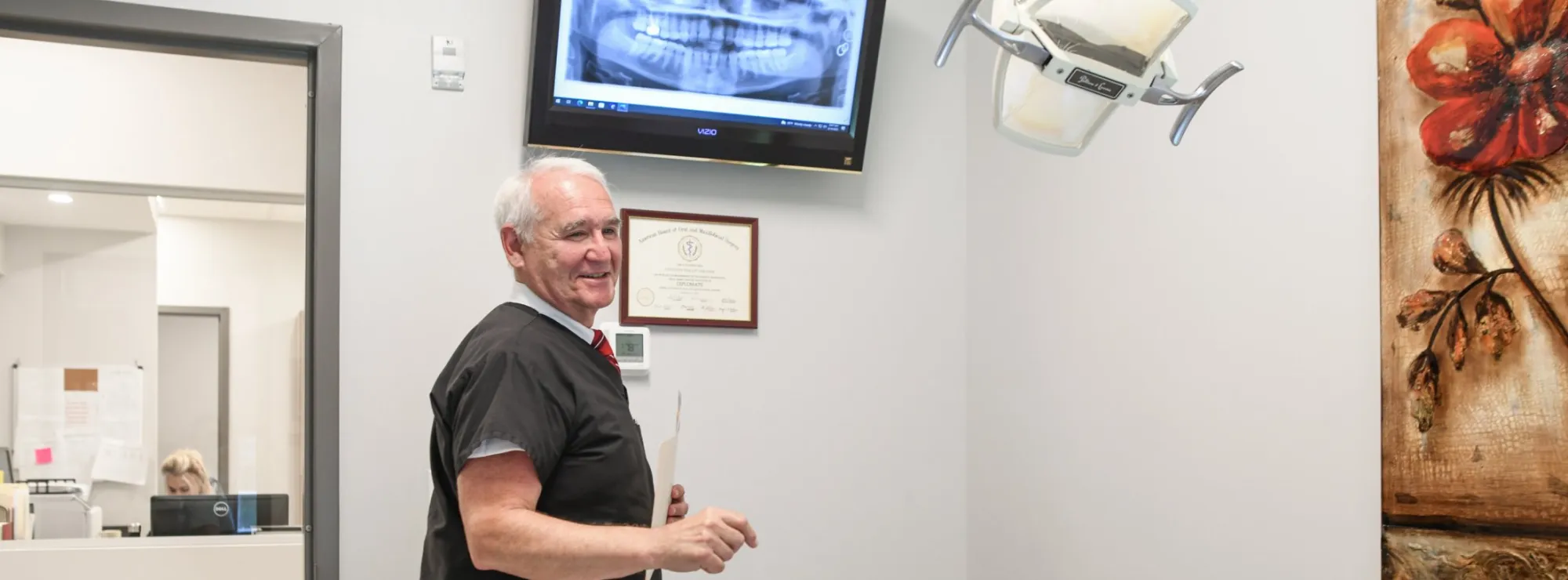
Here is a very common scenario. A patient presents to the dentist or Oral and Maxillofacial Surgeon with pain in or around the posterior mandible, (Jaw). A panoramic x-ray is taken which shows there is an impacted 3rd molar in the area. The doctor tells the patient that the pain must be coming from the impacted 3rd molar and recommends removal or the tooth and likely the other three wisdom teeth at the same time. The teeth are removed, and after the short post-operative recovery, the original pain persists.
The doctor never thought to consider TMD in his differential diagnosis when he heard the word “pain” and saw an impacted 3rd molar on the x ray. Unfortunately, this is a very common scenario. If the patient had impacted 3rd molars, they should have been removed anyway. But not treating the correct problem is a foolish mistake since it is so easy to distinguish between the two diseases. Pain is not always associated with impacted 3rd molars. Painful 3rd molars are present only in the presence of inflammation or infection around the tooth. This is similar to TMD in that the painful symptoms of TMD are only present when the is inflammation within the temporomandibular joint.
It is easy to differentiate between the two diseases. It just takes one finger.
Just press on the joint and press on the impacted 3rd molar.
Have the patient open the mouth widely and place a finger in the depression created in the TMJ. Press firmly and have the patient close their mouth quickly. If that creates pain, the joint is inflamed and the diagnosis is TMD. Place the same finger over the impacted 3rd molars and press firmly. If painful, remove the tooth. It’s not TMD. Very quick and very easy. There should never be any confusion about, “Is it TMD or is it Wisdom Teeth?”
Comments are closed.